Highland Cow Laser Engrave File: A Practical Guide for Crafters and Makers
The demand for rustic, farm-to-table aesthetics in home décor has surged in recent years, with the Highland cow emerging as a particularly popular motif. For laser engraving enthusiasts and small business owners, finding a digital asset that translates this specific look into a crisp, burnable image is often the most challenging part of the production process. The Highland Cow Laser Engrave File represents a specialized category of digital design optimized specifically for thermal marking processes rather than standard printing. Understanding what distinguishes these files from generic vector art or low-resolution raster images is essential for anyone looking to produce professional-grade wood crafts, stationery, or textile prints.
Understanding the Grayscale Advantage in Laser Engraving
At its core, a Highland Cow Laser Engrave File is distinct because it is engineered around the physics of how laser machines interpret data. Unlike vector files (SVG or DXF) which rely on lines and shapes, or simple black-and-white bitmaps which offer only two states (on or off), premium grayscale PNGs utilize hundreds of shades of gray to dictate the intensity of the laser beam. This capability allows for the rendering of complex textures, such as the shaggy coat of a Highland cow, without losing definition.
When a laser cutter processes a grayscale image, it varies the power output based on the brightness of each pixel. Darker areas receive more energy, creating deeper burns, while lighter areas receive less, resulting in subtle shading. This technique, known as dithering when applied by software like LightBurn, creates a three-dimensional effect that flat line art cannot achieve. The Premium Grayscale PNG format ensures that the intricate details of the animal's fur and facial features are preserved during the transfer from screen to material. For makers using CO2 laser cutters, Glowforge, or xTool devices, this high-resolution approach is often the deciding factor between a product that looks hand-drawn and one that appears professionally manufactured.
Resolution and Detail: Why 4096 x 4096 px Matters
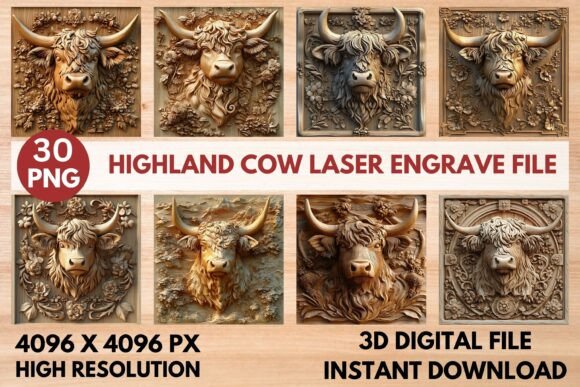
One of the primary technical specifications of a high-quality Highland Cow Laser Engrave File is its resolution. Files offered at 4096 x 4096 pixels provide a significant advantage over standard web-resolution images. When scaling an image down for a small keychain or up for a large wall plaque, pixelation can quickly ruin the aesthetic. A file with this level of detail ensures that even when resized to fit various product dimensions—from tableware to packaging—the edges remain sharp and the gradients smooth.
However, higher resolution comes with tradeoffs. Larger files require more processing time within laser software and may increase the engraving duration slightly due to the increased number of data points the machine must interpret. For projects where speed is the absolute priority and fine texture is secondary, a lower-resolution file might suffice. Yet, for applications demanding a "bold, rustic, and precise" look, the extra processing time is a necessary investment to avoid the jagged, blocky appearance common in poorly optimized designs.
Comparing Formats: Grayscale PNG vs. Vector and Bitmap
When evaluating resources for a new project, it is helpful to compare the Highland Cow Laser Engrave File against other common formats available in the digital marketplace. Each format serves a different purpose and yields distinct results depending on the desired outcome.
- Vector Files (SVG/EPS): These are ideal for cutting shapes out of wood or acrylic. They define the outline of the cow but lack internal shading. If the goal is to create a silhouette or a multi-layered cutout, vectors are superior. However, they cannot replicate the depth of fur texture seen in a grayscale engrave.
- Standard Black-and-White Bitmaps: These function similarly to dot-matrix printing. They create patterns using dots of varying sizes but often lack the smooth tonal transition required for realistic animal portraits. They can appear grainy if not processed correctly.
- Grayscale PNGs: This is the sweet spot for photorealistic or highly detailed textural engraving. The Highland Cow Laser Engrave File falls into this category, offering the nuance needed to capture the unique character of the breed.
For creators who need versatility, some bundles include both coloring PNGs and grayscale versions. The coloring options allow for post-processing creativity, such as adding paint or stain after the engraving, while the grayscale version is ready for immediate burning. Understanding this distinction helps users select the right tool for their specific workflow.
Machine Compatibility and Software Settings
The effectiveness of a Highland Cow Laser Engrave File is heavily dependent on the hardware and software used to execute the design. While these files are designed to be compatible with major platforms like LightBurn, xTool Creative Space, Glowforge, and Sculpfun, the user must ensure their machine supports PNG engraving. Not all entry-level machines handle raster data efficiently, and some older controllers may struggle with high-resolution grayscale inputs.
Software settings play a critical role in translating the digital file into a physical object. For instance, users of LightBurn are often advised to apply the Jarvis dither filter. This algorithm converts the grayscale values into a pattern of dots that mimics the original shading, ensuring accurate laser burning. Without the correct filter, the image may appear washed out or overly dark. Similarly, Glowforge users have specific recommendations, such as setting the speed to 1000 mm/min and power to 90%, with a focus on "Vary Power" modes to maximize quality. These settings are not universal; they must be adjusted based on the material being used. Lighter woods generally yield the best contrast for these designs, whereas darker woods may require masking or significantly different power settings to prevent charring.
Tradeoffs in Material Selection
While the design itself is versatile, the choice of substrate dictates the final result. The Highland Cow Laser Engrave File performs exceptionally well on birch plywood, basswood, and maple, where the natural grain complements the rustic theme. However, attempting to engrave this design on materials like black acrylic or leather requires a completely different approach. On dark surfaces, the laser removes material rather than burning it, meaning the grayscale logic of "darker = more power" does not apply in the same way. In such cases, the file might need to be inverted or converted to a vector outline, negating the benefits of the original grayscale optimization. Therefore, before purchasing or utilizing this file type, makers should evaluate whether their intended material aligns with the strengths of grayscale engraving.
Best Use Cases and Limitations
The Highland Cow Laser Engrave File is an excellent resource for specific types of projects but may not be the optimal choice for every scenario. It is ideally suited for home décor items like wall plaques, serving boards, and coasters where the texture of the wood enhances the visual appeal of the cow's fur. It is also effective for personalized gifts, such as engraved phone cases or wooden jewelry boxes, where a high level of detail adds perceived value.
Conversely, there are situations where this format is less suitable. If a project requires the design to be cut out rather than engraved, a vector file is mandatory. Additionally, for very large-scale signage where viewing distance is significant, the extreme detail of a 4096px file may be unnecessary, and a simpler line-art version could save time and material costs. Another limitation is the non-editable nature of the PNG format. Users cannot easily change the pose of the cow or remove elements like the horns without advanced photo editing skills. If customization of the subject matter is a priority, a vector-based illustration would offer greater flexibility.
Making an Informed Decision
Deciding whether to invest in a Highland Cow Laser Engrave File ultimately depends on the balance between desired aesthetic quality and production constraints. For makers prioritizing a photorealistic, textured finish that highlights the unique characteristics of the Highland cow, the premium grayscale PNG is the superior option. It eliminates the guesswork of converting photos to laser-ready formats and provides a consistent, professional result across multiple passes.
However, if the project demands rapid turnaround times, extensive geometric modification, or compatibility with materials that do not respond well to variable power engraving, alternative formats should be considered. By understanding the technical requirements—such as the need for Jarvis dithering in LightBurn or specific power/speed ratios for Glowforge—users can leverage these files effectively. The key is to match the file's capabilities with the machine's limitations and the material's properties. When aligned correctly, the Highland Cow Laser Engrave File becomes a powerful tool for creating high-value, rustic products that stand out in a crowded market.